admin2
18 November 2026
How to read an office fit-out quotation: BOQ structure, 8 hidden-cost points, a 3-contractor comparison and a 12-question checklist before you sign.
Two office fit-out quotations for the same drawing set can land far apart without either contractor writing a wrong number. The gap sits in what the quotation does not say: excluded work packages, materials with no specification, estimated quantities, building fees nobody has claimed. This guide shows how to read an office fit-out quotation and its bill of quantities (BOQ), points out the 8 places where cost tends to hide, and gives you 12 questions for comparing fit-out contractor quotes before you sign. It does not list general VND/m² price ranges; those are in the article on 2026 office interior fit-out quotations.
Why office fit-out quotations from different contractors are hard to compare
An office fit-out quotation is the product of three variables multiplied together: scope of work, material specification and quantity. The total at the bottom compares only when all three match. In practice each contractor decides what sits inside the price and what is left for the client, and that is usually where the "cheaper" number comes from.
Market averages need the same reading. In its 2025 Fit Out Cost Guide, Cushman & Wakefield builds Hanoi and Ho Chi Minh City fit-out costs from furniture, mechanical and electrical systems (M&E), general construction works, AV/IT equipment and other costs combined. If a contractor quotes a "finished-office rate" that leaves out air-conditioning, fire protection or loose furniture, that figure cannot sit next to another contractor's, even if both are written in VND/m².
A short rule for reading an office fit-out quotation: compare scope first, specification second, quantities third, and only then compare totals. To do that you need to know what a proper BOQ looks like.
What a proper interior fit-out BOQ looks like
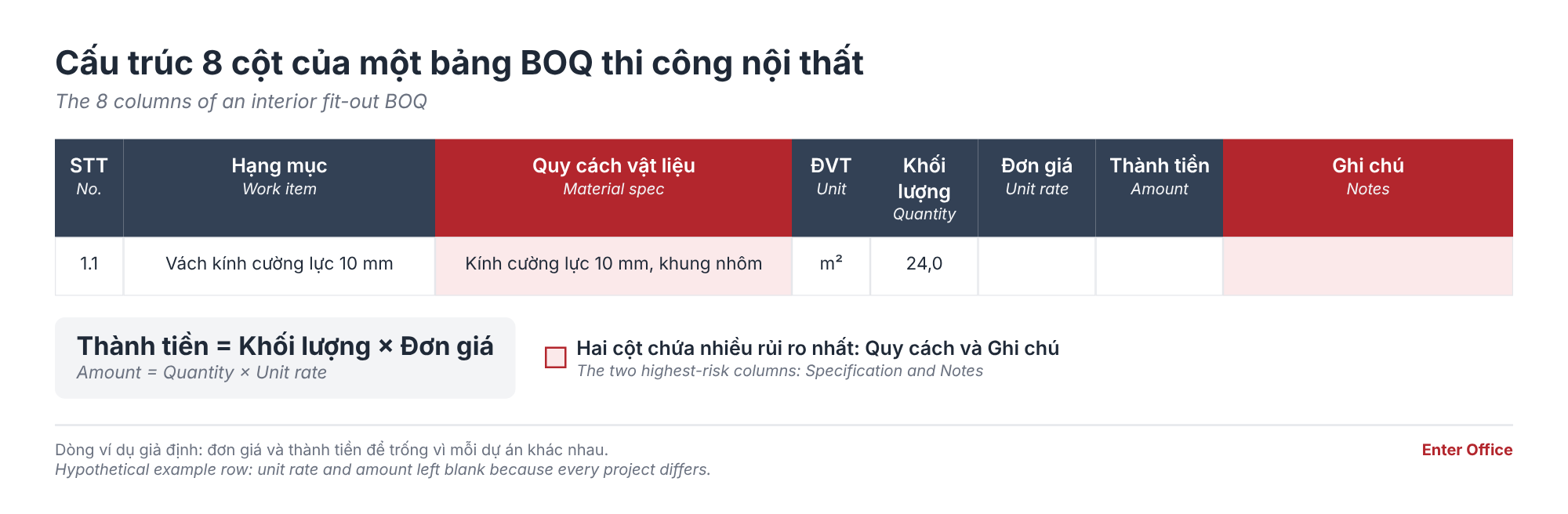
A BOQ (bill of quantities) lists every work item with its quantity, unit rate and amount. Clients use it to set a budget, compare contractors, verify completed quantities and release stage payments. A readable BOQ for an office interior needs these columns.
Column | Content | What to check |
|---|---|---|
No. / Item | Work description, grouped by trade (demolition, ceilings, partitions, flooring, painting, joinery, electrical, air-conditioning, fire protection) | Are all trades present? Does any line bundle several jobs into one "package"? |
Material specification / brand | Type, thickness, colour code, brand, origin | Is there enough detail to buy the right product, or only "premium" and "equivalent"? |
Unit | m², linear metre, set, piece, point | Does the unit fit the work (partitions in m², light fittings per set)? |
Quantity | Measured from drawings | Taken off from construction drawings, or estimated from floor area? |
Unit rate | Price per unit including materials, labour and plant | Does it include wastage, hoisting to the floor and installation? |
Amount | Quantity multiplied by unit rate | Does it add up to the total? Any hand-typed lines without a multiplication? |
Notes | Conditions, exclusions, provisional items | The highest-risk column. Read every line. |
On how price is built up: Vietnamese rules on construction investment cost management split an estimate into direct costs (materials, labour, construction plant), overheads, pre-tax profit and VAT, plus a contingency for quantity changes and price escalation. The older framework is Decree 10/2021/ND-CP; from 1 July 2026, cost management is detailed in Decree 206/2026/ND-CP. A company's fit-out contract does not have to follow this format, but it is a useful reference: a serious BOQ lets you see each layer separately. If the quotation is a single line reading "construction, lump sum" and one number, you do not have a BOQ. You have a price.
8 places where costs hide in an office fit-out quotation
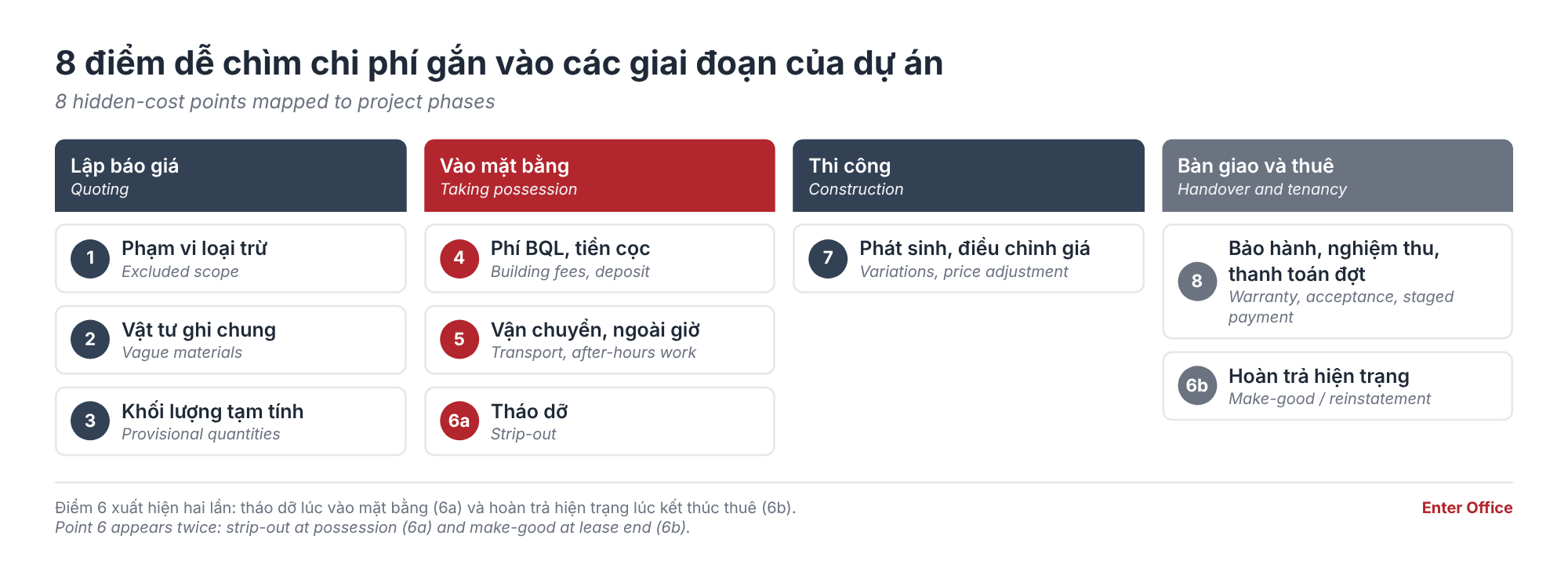
The eight points below recur whenever several quotations are placed side by side. Each comes with a warning sign and a way to pin it down in writing.
1. Excluded scope: M&E, fire protection, air-conditioning
This is the largest source of gaps in an office fit-out quotation. A quotation may read "interior finishing" while the notes column says "excludes air-conditioning, fire protection and data cabling". Some buildings require fire protection or air-conditioning work to be done or approved by the building's own contractor; the cost still exists, it just sits outside the interior contractor's price.
How to pin it down: require a separate "Exclusions" section in every quotation, and split M&E into independent lines: power, lighting, data and voice, indoor units, ductwork and diffusers, and the sprinkler heads and detectors that must be moved or added when partitions and ceilings change. For every excluded item, ask who does it and at what cost.
2. Materials with no specification
"Engineered wood with surface finish", "premium paint", "recessed LED lights" are lines that give you nothing to compare. Under the same words "engineered wood", an MDF or MFC core, 17 mm or 18 mm thick, melamine or laminate faced, each carries a different price and a different service life.
A compliant line states: material type and thickness (mm), surface finish, brand and colour code; for paint, the brand, product line and number of coats; for lighting, wattage (W), colour temperature (K) and brand; for hardware, the hinge and runner brand. "Or equivalent" is acceptable only if the contract defines the equivalence criteria and any substitution is confirmed in writing. For the differences between material groups, see the 2026 office interior material price list.
3. Provisional quantities
There are two kinds of quantities: taken off from construction drawings, and estimated from floor area. The second appears when the contractor quotes before detailed drawings exist. A line marked "1 lot", "provisional" or "PC sum" is a place where the price can move after signing.
How to pin it down: ask what percentage of the contract value the provisional lines represent. If it is large, the quotation is not mature enough to compare. Ask the contractor to state when quantities will be re-measured and whether the final account follows actual quantities or stays fixed.
4. Building management fees and deposits: who pays
Office buildings commonly charge during fit-out: a works deposit, supervision fee, goods-lift charge, cleaning fee, and power for construction. One hidden-cost guide from an office leasing operator puts building management charges during works at roughly 10,000 - 50,000 VND/m² and construction power at roughly 5 - 15 million VND, depending on the duration of works. These are reference figures only; actual amounts depend on each building's rules.
The quotation should carry a separate line for this group of costs and state who pays the fee, who bears the cost, and to whom and when the deposit is refunded. Confirm the procedure and documents with the building management as soon as a works plan exists, before locking the programme.
5. Material transport and after-hours work
Glass, stone, long partition panels and heavy equipment are usually allowed into a building only through the goods lift in set time windows, and many buildings specify nights or weekends. According to the same hidden-cost guide, after-hours charges for power, air-conditioning, lifts or security can run at about 100,000 - 500,000 VND per hour, which is a reference figure that changes by building.
The quotation should answer: how many after-hours shifts does the contractor assume, is night-shift labour priced in, and are transport to the floor and handling inside the unit rate or on a separate line. A contractor who stays silent here often lets the cost slide into variations.
6. Stripping out and reinstatement
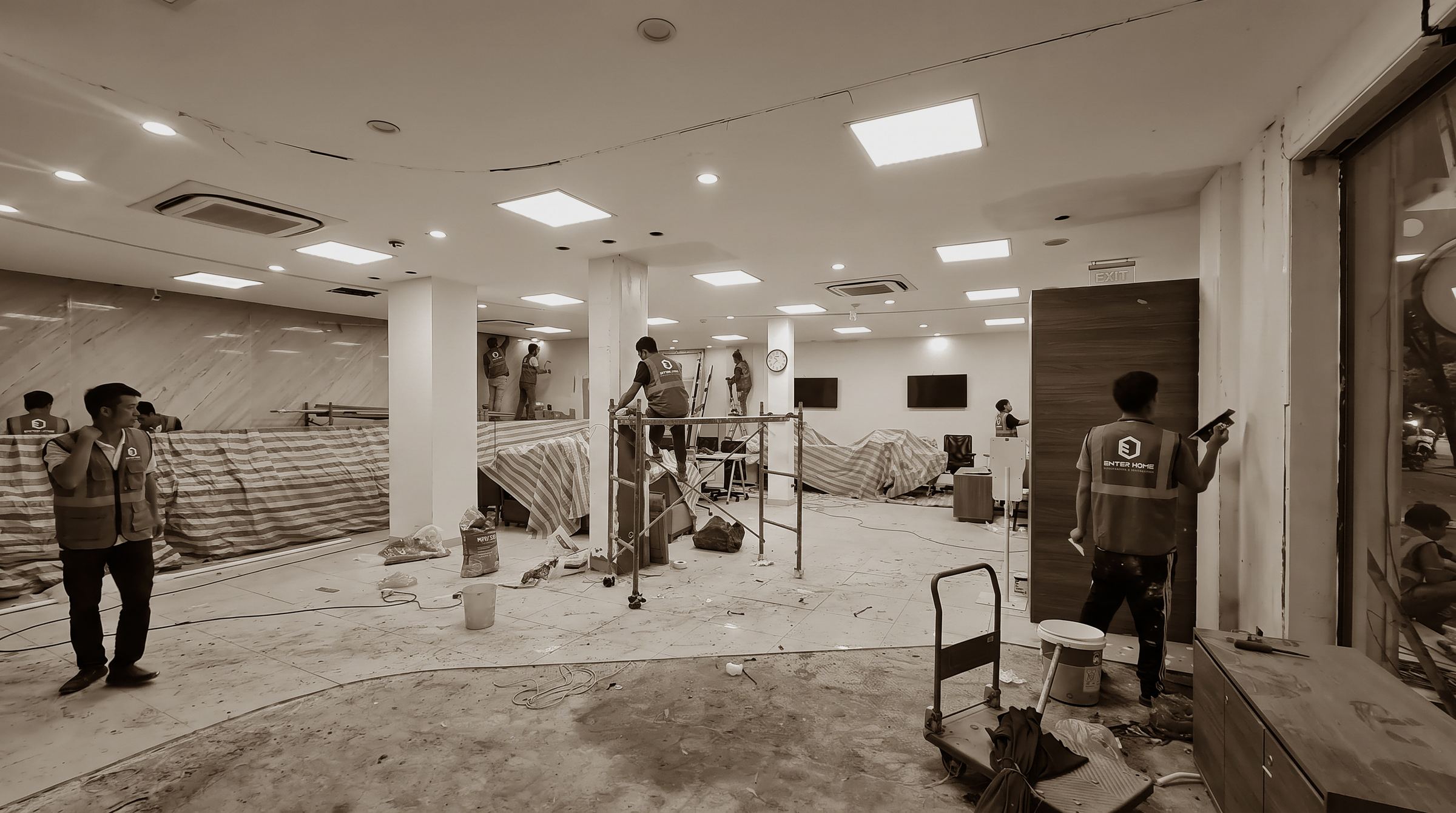
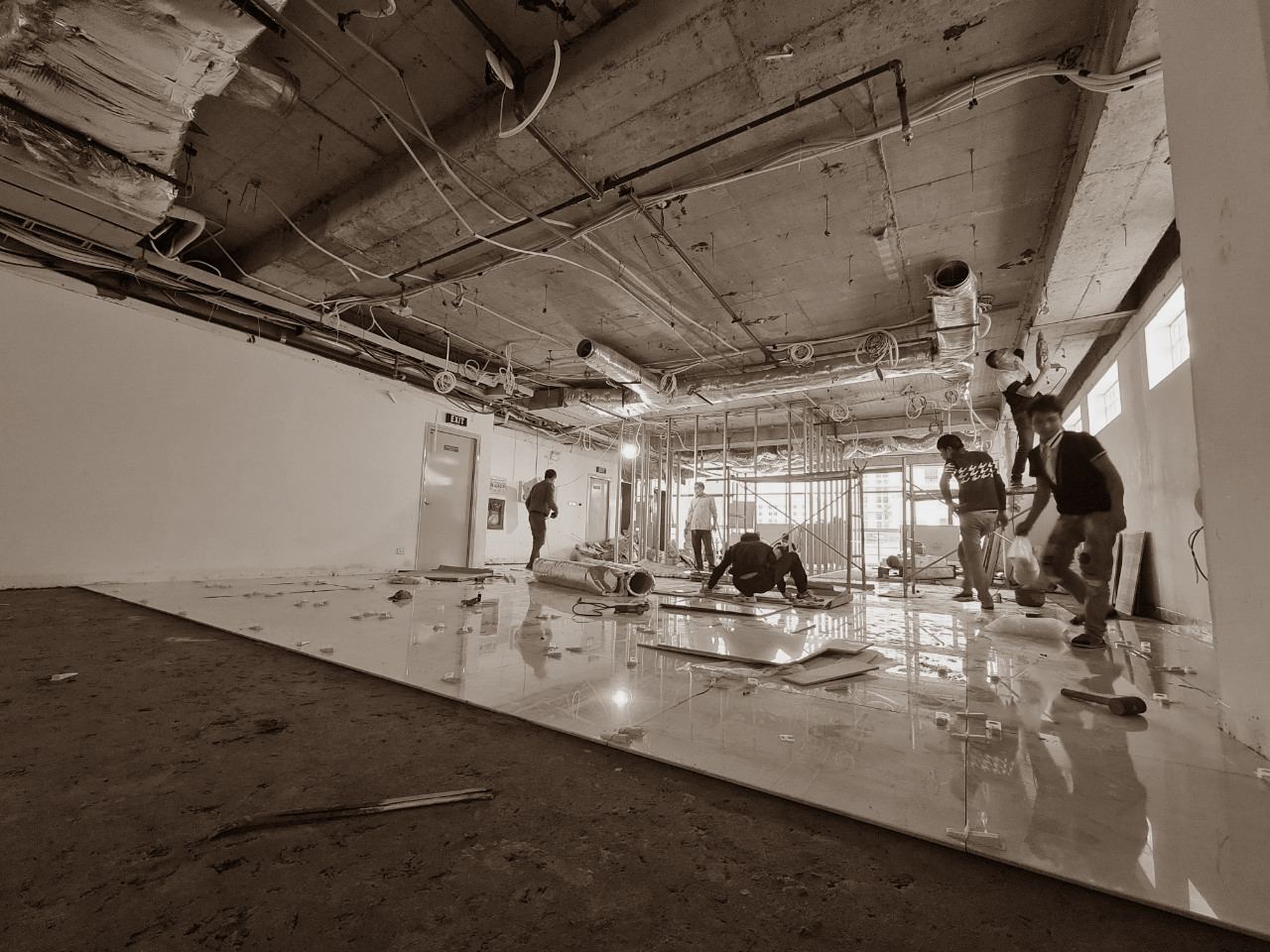
This point has two ends. At the start of the works: stripping out the previous tenant's partitions, ceilings and floors, hauling away waste, and industrial cleaning. A quotation with no strip-out line for a previously occupied floor is a sign to ask again. At the end of the lease: many leases require the tenant to reinstate the premises (make-good). The hidden-cost guide above estimates this can reach tens to hundreds of millions of VND, and if reinstatement is incomplete the landlord may hire another contractor at higher rates and apply penalties.
How to handle it: read the reinstatement clause in the lease before approving the design, so that partitions, ceilings and floors can be chosen to be easy to remove from day one. Ask the contractor whether the quotation includes initial strip-out and whether it estimates reinstatement cost.
7. Variations and price adjustment clauses
A "lump-sum" quotation does not mean "no variations". The 2025 Construction Law (effective 1 July 2026) classifies contracts by price form, including lump sum, fixed unit rate, adjustable unit rate and others, and requires amendments to quantities, unit rates and contract price to be made in writing. According to summaries of Decree 210/2026/ND-CP, a lump-sum price can still be adjusted for force majeure, a fundamental change of circumstances, a change in scope of work, or cases the parties agreed in advance. For your own contract, have legal counsel check the specific clauses.
In the quotation and contract you should be able to see three things: which price form applies; that a variation takes effect only with a written request and a signed approval; and that variation rates come from the unit rates in the original BOQ. It also helps to separate three sources of variation: the client changing requirements, concealed existing conditions (buried pipes, uneven slab, building power capacity), and the contractor missing an item when compiling the BOQ. The third needs the parties to agree responsibility before signing.
8. Warranty, acceptance, stage payments
These three clauses decide what leverage you still have after handover. Warranty should be stated per trade: joinery, electrical, air-conditioning, paint and glass carry different periods; plus the scope of warranty and the contractor's response time. Acceptance needs a record per work item and a punch list with deadlines for rectification. Payment should be tied to completed-quantity milestones, with a percentage retained until the end of the warranty. According to summaries of Decree 210/2026/ND-CP, the performance security range in the general legal framework remains about 2% - 10% of contract value; for a fit-out contract, the specific percentage is agreed between the parties.
Also check whether the quotation includes VAT. A quotation excluding VAT can look cheaper than what you will actually pay.
Comparing fit-out contractor quotes: a three-contractor example
The table below uses assumed figures to illustrate how to read quotes. It is not a real quotation from any company and does not reflect market unit rates. Three contractors quote the same drawing set. Unit: million VND, excluding VAT.
Item | Contractor A | Contractor B | Contractor C |
|---|---|---|---|
Ceilings, partitions, flooring, paint | 520 | 560 | 575 |
Fixed and loose furniture | 310 | 330 | 340 |
Electrical, lighting, data | 180 | 195 | 200 |
Air-conditioning, ventilation | Excluded | 240 | 230 |
Fire protection | Excluded | 85 | Provisional 40 |
Strip-out, waste removal, cleaning | Not stated | 45 | 40 |
Transport, after-hours labour | Not stated | 25 | 30 |
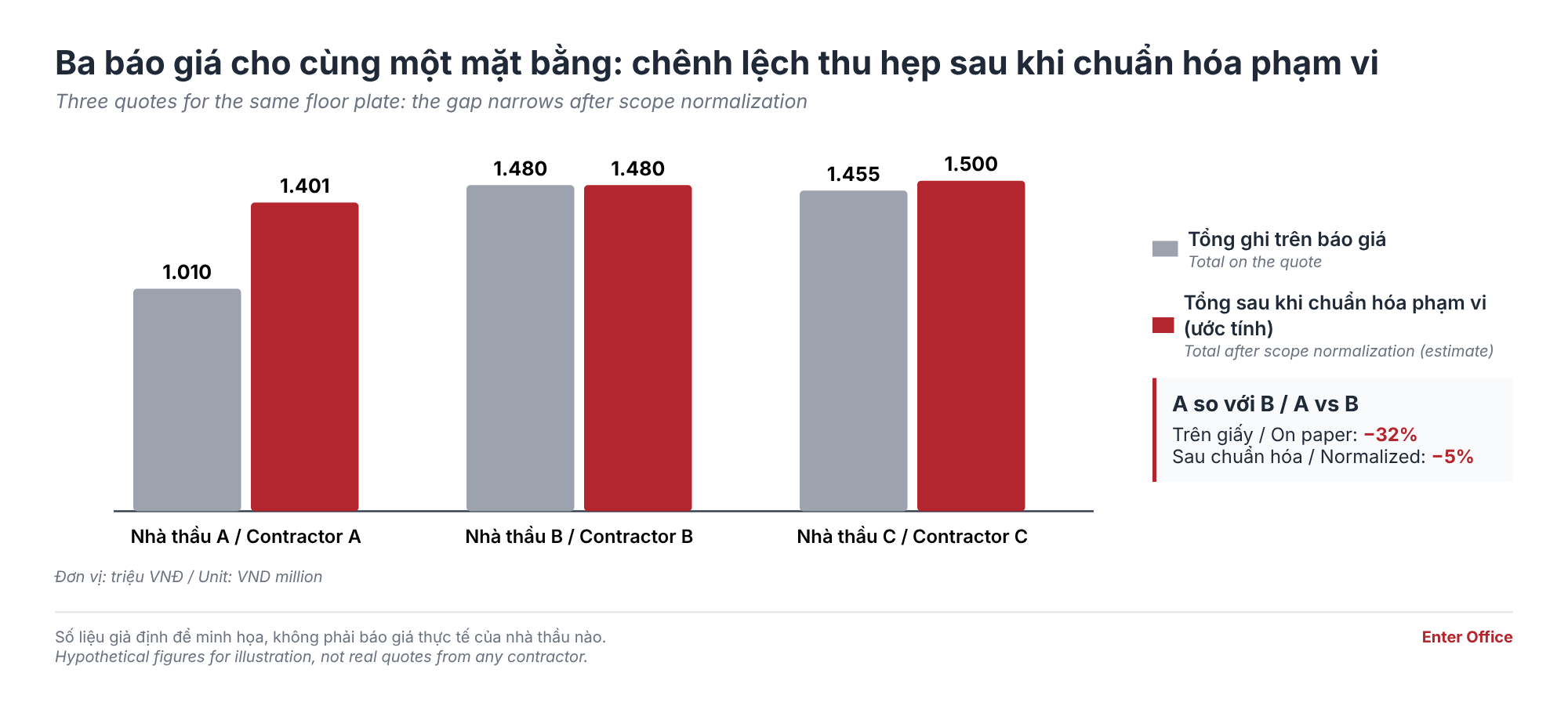
Total as quoted | 1,010 | 1,480 | 1,455 |
Total after scope normalisation (estimate) | 1,401 | 1,480 | 1,500 |
Reading the table: on paper A is about 32% cheaper than B. Normalising works like this: lines A excludes or leaves unstated are filled with the average of B and C (air-conditioning 235, strip-out 43, transport 28), and fire protection takes B's figure of 85; C's provisional fire protection line of 40 is replaced by 85. The result: A is only about 5% below B, and C comes out above B. The 32% gap narrows to about 5% because most of the original difference came from items A had not priced.
Four normalisation steps you can run immediately: build a table on the same item axis as above; for every "excluded" or "not stated" cell, ask the contractor for a written addition, or fill it provisionally with the level of the other quotes; replace every provisional sum with a confirmed figure; compare the total, then compare payment terms and warranty. The lowest office fit-out quotation after normalisation is not necessarily the one to choose, but you are comparing far more fairly.
12-question checklist for contractors before you sign
Print this list and send it to each contractor together with your request for an office fit-out quotation. Ask for written answers.
Which drawings, revision and date is the quotation based on?
Which items are excluded from the price (M&E, fire protection, air-conditioning, data, AV, curtains, loose furniture, signage)?
Does each material state type, thickness, brand and code, and what are the conditions for substituting an "equivalent"?
Were quantities taken off construction drawings or estimated from floor area?
What percentage of contract value do provisional lines make up, and is the final account based on actual quantities or fixed?
Who pays the building management fees, works deposit and construction power, who bears the cost, and who receives the deposit refund?
What are the permitted working hours under the building rules, and how many after-hours shifts has the contractor priced?
Are transport, handling and goods-lift charges inside the unit rates?
Are strip-out of existing fit-out, waste haulage and industrial cleaning in the price?
Which price form applies (lump sum, fixed unit rate, adjustable unit rate), and what are the conditions for price adjustment?
How are variations approved, where do variation rates come from, and is there a cap?
What is the warranty period per trade, what percentage is retained, which acceptance records apply, how many stage payments are tied to which milestones, and is VAT included?
Why design, estimating and construction under one lead reduce BOQ mismatch
When design, estimating and construction sit with three different parties, the BOQ is usually compiled after the drawings by someone who will not build the work. The familiar consequences: the drawing specifies one material and the BOQ prices another; measured quantities differ from actual ones; when they diverge, each party answers only for its own piece and the client pays the difference.
In the Design & Build model, drawings, BOQ and construction method are built on one set of documents, starting from the Test Fit plan. One lead answers for all three stages, so the question "who pays when the BOQ missed an item" has someone to answer it. This reduces the risk of drawing-to-BOQ mismatch but does not eliminate variations: client changes and concealed conditions still occur, and you still need a detailed BOQ rather than a single lump figure. The process and the criteria for choosing a Design & Build provider are covered in turnkey office interior design and build from A to Z.
A tight programme makes this more visible. On the Dong Do Partners Hong Ha branch (Ho Chi Minh City), a 200 m² office built in 18 days, there was no time to re-measure quantities after signing. The BOQ had to match the drawings from day one. Enter Office does not publish a fixed price list; estimates are prepared from the floor plan, existing conditions and the building's requirements.
Considering a floor but not sure how many people it can seat? How much will the fit-out cost? Send your CAD or PDF floor plan to Enter Office now. We will prepare a Test Fit plan (a preliminary space layout) FREE within 48 hours so you can make the most accurate decision.
Register for a Free Test Fit Plan · Send Your Floor Plan Now
The order for locking an office fit-out quotation before signing
Work in this order: lock the drawings and scope, lock material specifications, lock quantities, lock the building's fees, then lock the variation, warranty and payment clauses. Only when those steps match across contractors does the total on each office fit-out quotation mean anything. For clean input to the first step, send your floor plan and receive a free Test Fit plan within 48 hours, then use it as the common drawing for every quotation you request.
Frequently asked questions
How is a BOQ different from an ordinary quotation?
An ordinary office fit-out quotation may be a few lines and a total. A BOQ lists each item with its specification, unit, quantity, unit rate and amount, so you can check, reconcile and accept work line by line. When comparing contractors, ask for the detailed BOQ together with the total.
How many contractors should I ask for a quotation?
Two to three is enough to see the price level and how each party divides the scope. This is practical experience, not a rule. More makes normalising scope laborious for little extra value. The condition is that all of them receive the same drawing set and the same technical requirements.
Does a lump-sum office fit-out quotation mean no variations?
No. Lump sum means the price is fixed for the scope signed. When the scope changes, in cases of force majeure or a fundamental change of circumstances, or in cases the parties agreed in advance, the price can still be adjusted, and the adjustment must be made in writing. What matters is that the scope in the contract is detailed enough to leave no argument about which items belong to it.
Who pays building management fees and the works deposit?
There is no general rule; it is agreed between the parties and depends on each building's regulations. State it explicitly in the quotation or contract: who pays, who bears the cost, and to whom and when the deposit is refunded. Confirm with the building management in advance so the figure in the quotation does not need to be revised later.